This page isn’t just about asking and answering “what time is it” in Spanish, it also covers days, months, years and dates too!
This guide comes with reference tables, audio downloads for practicing pronunciation, and there’s even a dynamic assistant to help you cheat should you need a little extra guidance!
Before you can tell the time you need to know Spanish numbers!

What time is it? ¿Qué hora es?
There are a couple of different ways to ask (or be asked) about the time in English, it’s the same in Spanish:
- Excuse me, what time is it? = Disculpe, ¿qué hora es?
- Do you have the time, please? = ¿Tienes hora, por favor?
Midnight and midday
To say it’s midnight use es medianoche.
To say it’s midday use es mediodía.
01:00 / 13:00 = It is the one! / ¡Es la una!
When it’s one o’clock, it is the one!
That’s the literal translation of es la una.
Five past one is es la una y cinco.
02-11 and 14-23 = Everything else is son las
To say it’s two o’clock in Spanish it’s son las dos, or tres etc.
Five past two is son las dos y cinco.
If you think of son las as the default of how to say “it’s” and remember that one is the one, es la una, and is special, you’ve cracked it.
Minutes past the hour = hour and minutes
In English for 10:10 / 22:10 we’d say “it’s 10 past 10“, in Spanish they say “son las diez y diez” which is akin to saying “it’s ten and ten” so instead of thinking “minutes past hour”, think “hour and minutes”.
The first thirty minutes in an hour count up.
Minutes to hour = next hour minus minutes
The final thirty minutes in the hour count down to the next hour.
05:55 and 17:55 are both five to six in English, this becomes six minus five, son las seis menos cinco in Spanish. Instead of minutes to the next hour, it’s the next hour minus minutes.
- 01:33 / 13:33 = es la una y treinta y tres.
- 09:35 / 21:35 = son las diez menos veinticinco
- 10:50 / 22:50 = son las once menos diez
It’s quarter past / quarter to = y cuarto / menos cuarto
Quarter past is hour y cuarto, son las tres y cuarto.
Quarter to is next hour menos cuarto, son las cinco menos cuarto.
It’s half past = y media
Half-past is hour y media, es la una y media, son las tres y media.
Basic Times in Spanish
| Time | Hora |
| 01:00 – 13:00 | Es la una. |
| 01:15 – 13:15 | Es la una y cuarto. |
| 02:29 – 14:29 | Son las dos y veintinueve. |
| 05:30 – 17:30 | Son las cinco y media. |
| 08:45 / 20:45 | Son las nueve menos cuarto. |
| 11:59 – 23:59 | Son las doce menos uno. |
The Hours in Spanish
If we remember midnight is medianoche and midday is mediodía, and that one is always the one, es la una, the rest is simply remembering son las and the hour.
| Hours | Horas |
| 00 | ¡Es medianoche! |
| 01 / 13 | Es la una |
| 02 / 14 | Son las dos |
| 03 / 15 | Son las tres |
| 04 / 16 | Son las cuatro |
| 05 / 17 | Son las cinco |
| 06 / 18 | Son las seis |
| 07 / 19 | Son las siete |
| 08 / 20 | Son las ocho |
| 09 / 21 | Son las nueve |
| 10 / 22 | Son las diez |
| 11 / 23 | Son las once |
| 12 | ¡Es mediodía! |
Morning, afternoon and night
Morning in Spanish is mañana which also means tomorrow and can be used as a casual way for saying ‘later’ that avoids committing to a time.
Mañana is very much a cultural thing, a vibe and an attitude, there’s no rush, everything is tranquilo, chill a bit, it happens when it happens, when’s it happening? Mañana…
- Morning = la mañana.
- Afternoon = la tarde.
- Evening = la tarde or la noche.
- Night = la noche.
Spanish doesn’t have a word for evening, it’s still la tarde as long as it’s still light, once the sun goes down it’s la noche.
In versus of
In English we think of things as being in the morning, in the afternoon or in the evening, so naturally our first instinct would be to think it’s going to be “cuatro en la mañana” for four in the morning, but in Spanish it’s not “in“, it’s “of“.
- Four of the morning, cuatro de la mañana.
- Five of the afternoon, cinco de la tarde.
- Nine of the night, nueve de la noche.
Greetings!
- Good morning = ¡Buenos días!
- Good afternoon = ¡Buenas tardes!
- Good night = ¡Buenas noches!
- Anytime = ¡Buenas!
Buenas is one of my favourite Spanish words, it’s almost vibe defining. It works for hi and hey, good and depending on the inflection great.
It’s not just what you’re saying, it’s how you say it too. Buenas is good and ¡bueeeenaaaas! takes it closer to the realm of WOW!
You might have spotted there are two ways to say good in that list!
The Spanish word for days, días, and all the days themselves, lunes, martes, etc, are all masculine so buenos is used.
Afternoons and nights are both feminine, so buenas is used.
- El día, the day.
- Los días, the days.
- La noche, the night.
- Las noches, the nights.
The, the, the and the
We’ve gone from two words for good, to four words for the!
- El = a masculine singular.
- Los = a masculine plural.
- La = a feminine singular.
- Las = a feminine plural.
You might think it’s confusing because English only has one “the” but remember we’re the ones with they’re, their, there and there’s – and to be fair, a lot of Brits don’t know the difference between them…
Confused about genders in Spanish? Blame the Romans, blame Centurions, but remember, there are a hundred of them so you’re outnumbered!
Give it some time, tiempo and you’ll figure it out, but it hardly helps that tiempo is both time and weather depending on the context!
The Minutes in Spanish
| Minutes | “y minutos” | “menos minutos” |
| 01 / 31 | y uno | menos veintinueve |
| 02 / 32 | y dos | menos veintiocho |
| 03 / 33 | y tres | menos veintisiete |
| 04 / 34 | y cuatro | menos veintiséis |
| 05 / 35 | y cinco | menos veinticinco |
| 10 / 40 | y diez | menos veinte |
| 11 / 41 | y once | menos diecinueve |
| 12 / 42 | y doce | menos dieciocho |
| 13 / 43 | y trece | menos diecisiete |
| 14 / 44 | y catorce | menos dieciséis |
| 15 / 45 | y cuarto | menos cuarto |
| 16 / 46 | y dieciséis | menos catorce |
| 17 / 47 | y diecisiete | menos trece |
| 18 / 48 | y dieciocho | menos doce |
| 19 / 49 | y diecinueve | menos once |
| 20 / 50 | y veinte | menos diez |
| 21 / 51 | y veintiuno | menos nueve |
| 22 / 52 | y veintidós | menos ocho |
| 23 / 53 | y veintitrés | menos siete |
| 25 / 55 | y veinticinco | menos cinco |
| 30 / 00 | y media | en punto |
Days of the week in Spanish
Spanish days of the week only need a capital letter if they’re at the start of a sentence.
| Days | Días |
| Monday | Lunes |
| Tuesday | Martes |
| Wednesday | Miércoles |
| Thursday | Jueves |
| Friday | Viernes |
| Saturday | Sábado |
| Sunday | Domingo |
Yesterday, today and tomorrow
Yesterday is ayer, today is hoy and among other things, mañana is tomorrow.
- Yesterday was Thursday, ayer fue jueves.
- Today is Friday, hoy es viernes.
- Saturday is tomorrow, El sábado es mañana.
Remember the H of hoy is silent!
In English we’d say “Saturday is tomorrow” but in Spanish they would say “The Saturday is tomorrow”, El sábado es mañana.
- The day before yesterday = anteayer.
- The day after tomorrow = pasado mañana.
- This morning: esta mañana.
- This week: esta semana.
The months in Spanish
Like the days, Spanish months only need a capital letter at the start when it’s the first word in a sentence.
| Months | Meses |
| January | Enero |
| February | Febrero |
| March | Marzo |
| April | Abril |
| May | Mayo |
| June | Junio |
| July | Julio |
| August | Agosto |
| September | Septiembre |
| October | Octubre |
| November | Noviembre |
| December | Diciembre |
How to say years in Spanish
In English we pair centuries with decades, like nineteen and eighty four, however the Spanish way is to pronounce the full number, so rather than 1984, it’s one thousand, nine hundred and eighty four,
- 2026 = dos mil veintiséis.
- 2000 = dos mil.
- 1999 = mil novecientos noventa y nueve.
- 1984 = mil novecientos ochenta y cuatro.
English to Spanish Time, Day and Date Translation Tool
For when you just want to cheat because two ways to say good and four ways to say the has boggled your brain… And if you think that’s mad, how many meanings does que have? ¡Muchos!
What time is it in Spain?
Spanish Days of the Week
Spanish Months
Spanish Date Converter

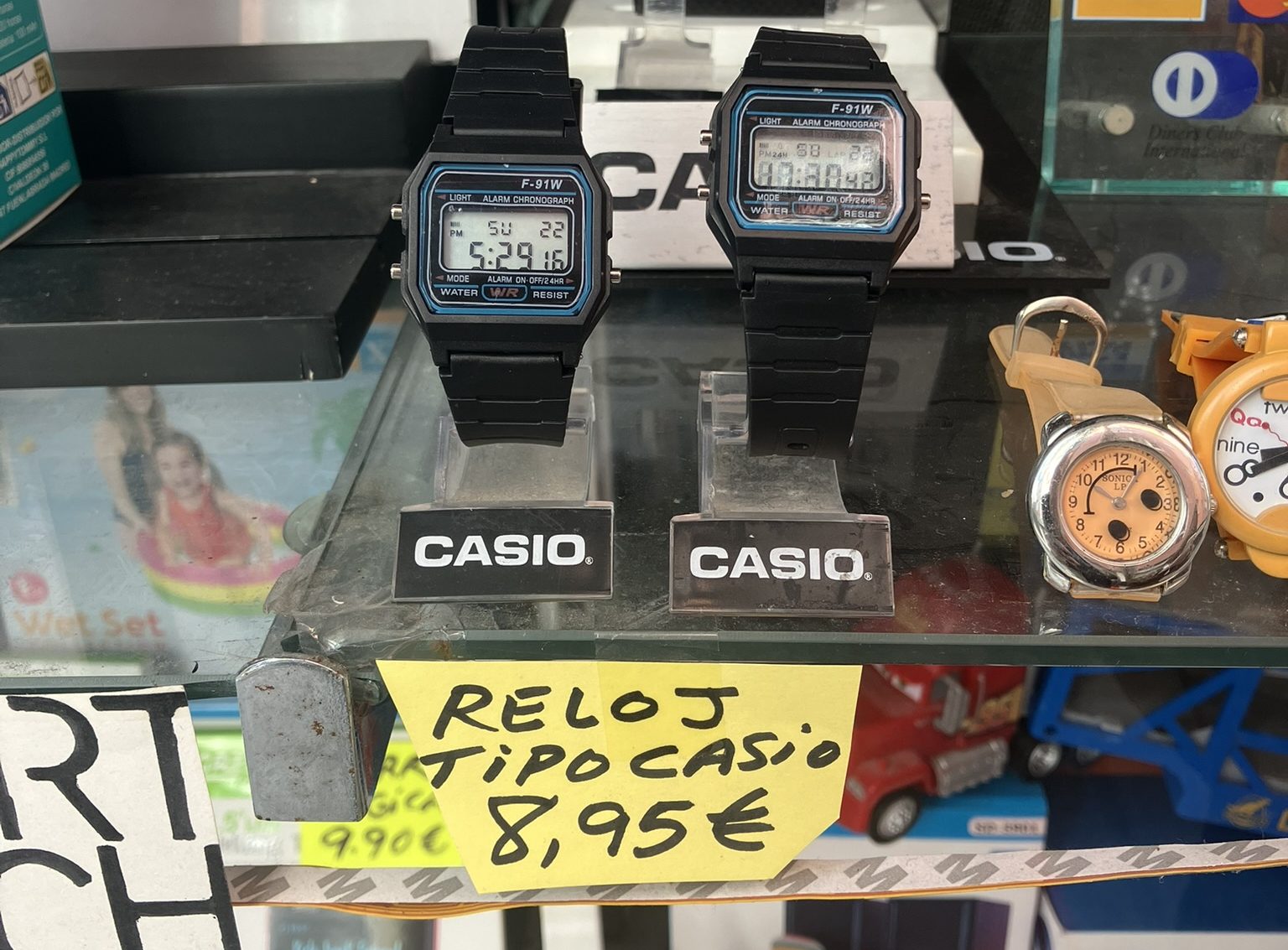
Featured image: a shop on Calla Sagasta📍 selling Casio watches for €8.95, they’re £14 in Argos and if you spot the same model in Duty Free expect it to set you back at least £20.